First Time in Cambodia: More Than Angkor (But Start With Angkor)
A calm 10 to 14 day route for first-timers, from a smart three-day temple order in Siem Reap to Phnom Penh, Kampot and the islands. With a free companion map of 36 pinned places.
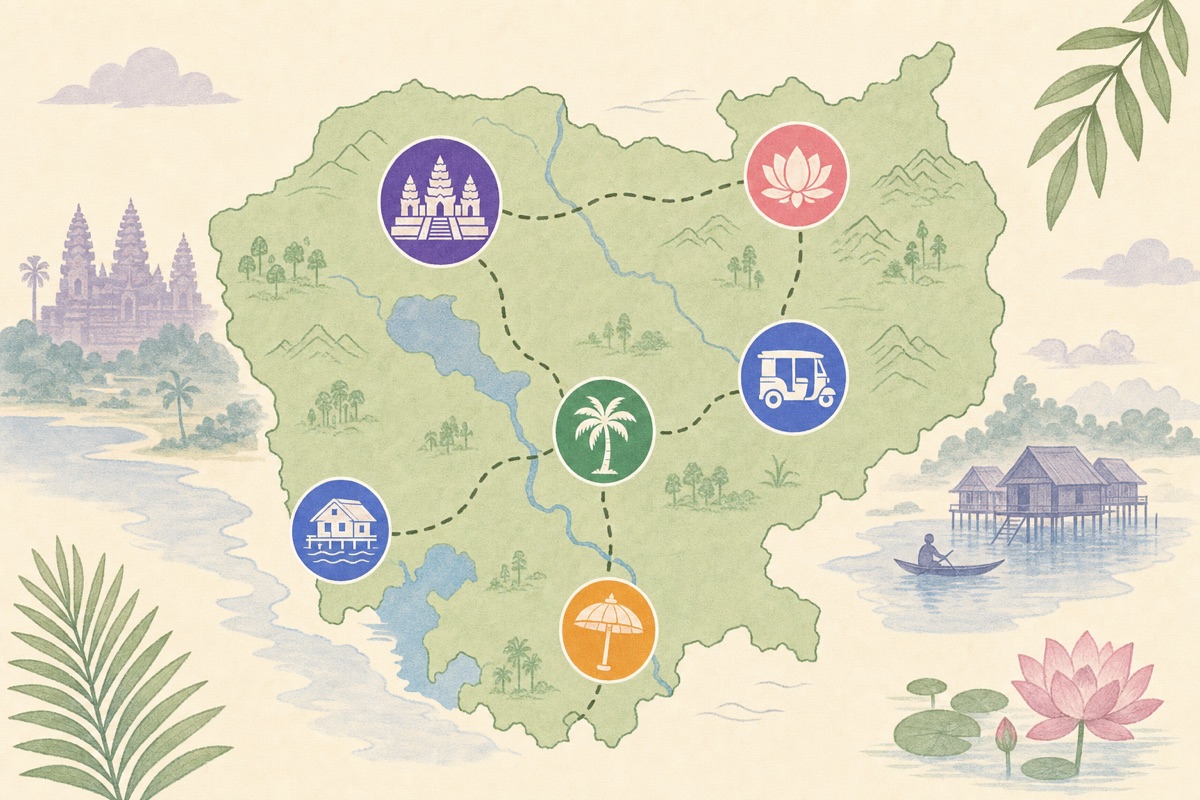
Almost everyone comes to Cambodia for one reason: Angkor. And that's fine, Angkor deserves it. But the travelers who give the country ten days instead of three come home talking about Kampot evenings, island beaches with nobody on them, and the kindest people they met all year. The temples get you on the plane. Cambodia itself is why you'll want to come back.
Here's a first-timer route that works in 10 to 14 days, plus the honest tips I wish someone had given me.
Siem Reap: three days, in the right order
Siem Reap is the base for Angkor, and three full days is the sweet spot. One day feels like a checklist, two is rushed, three lets you breathe.
Day one, the classics. Angkor Wat at sunrise, yes, with everyone else. It's crowded and it's still worth it. When the sunrise crowd floods into the temple, do the opposite: head to Angkor Thom instead. Enter through the South Gate with its causeway of stone faces, then spend the late morning at the Bayon, whose towers of smiling faces are the image of Cambodia you didn't know you already had. Come back to Angkor Wat mid-afternoon when the tour groups have thinned. If you have energy left, Phnom Bakheng is the classic sunset hill, but expect company.
Day two, the atmosphere. Ta Prohm, the temple being slowly swallowed by tree roots, is magical at opening time and a scrum by mid-morning, so go first. Then take the quieter big loop: Preah Khan, a long, half-ruined corridor temple that most groups skip, and Neak Pean, a small island shrine sitting in the middle of a reservoir. This is the day Angkor stops being a photo and starts being a place.
Day three, out and around. Banteay Srei is 30 to 40 minutes out of town and has the finest carvings in the whole complex, in pink sandstone. Go in the morning, then spend the afternoon back in Siem Reap: the Angkor National Museum makes far more sense after you've seen the real thing, and Pub Street and the Old Market are exactly what they sound like, touristy and fun. In the evening, book Phare, the Cambodian circus. It's a social enterprise training young performers, and it's genuinely one of the best nights out in the country.
If the water level is right, Kampong Phluk, a stilted village on the Tonle Sap lake, makes a good half-day add-on. More on that below, because floating village tours need a caveat.
Phnom Penh: two days, handled with care
The capital gets skipped by a lot of travelers, and that's a mistake. Give it two days.
One of them should be hard. Tuol Sleng, the school turned prison known as S-21, and Choeung Ek, the killing fields outside town, document the Khmer Rouge years with unflinching honesty. Take the audio guides, go quietly, and don't rush. It's heavy, and it should be. You cannot understand modern Cambodia, or why the warmth you meet everywhere means what it means, without understanding what happened here within living memory. Do both in one day, then give yourself a gentle evening on Sisowath Quay, the riverfront promenade where the city comes out to walk at dusk.
The other day is the pleasant one: the Royal Palace and the Silver Pagoda, the National Museum with its beautiful Angkorian sculpture (again, better after Angkor than before), Wat Phnom on its little hill, and the Central Market, a huge art deco dome full of everything. All of these sit on the companion map for this article, so you can see how they cluster and plan your walking accordingly.
Then slow down: Kampot and Kep, or the islands
After temples and history you'll want slow days, and the south coast delivers two flavors.
The river option. Kampot's old town is crumbling French shophouses, riverside cafes and not much to do, which is the point. From there, day trips write themselves: Bokor Hill Station, an abandoned French hill resort in the clouds, and La Plantation, a pepper farm where you learn why Kampot pepper is famous. Half an hour away, Kep is a sleepy seaside town whose crab market is the culinary highlight of the coast. Eat crab with green Kampot pepper and you'll understand. From Kep, a short boat ride reaches Rabbit Island, rustic and lovely.
The island option. From Sihanoukville, boats run to Koh Rong and Koh Rong Samloem. Long Beach on Koh Rong is a genuinely spectacular stretch of white sand, and Saracen Bay on Samloem is the calmer, prettier base. Otres Beach on the mainland works as a jump-off point. Two or three nights is plenty.
With 14 days you can do both. With 10, pick one.
Honest tips
The Angkor Pass. Buy the multi-day pass, not the single day. Three days at Angkor is not three times one day, it's a completely different experience, and consecutive days aren't required, so you can rest in between.
Hire a tuk-tuk driver as a day guide. Agree on a day rate, and if you get on well, book the same driver for all three temple days. A good driver knows the crowd rhythms better than any blog, times your stops, and waits with cold water. It's the best money you'll spend in Siem Reap.
Floating villages, with eyes open. Kampong Phluk is worth it in and after the wet season, when the stilted houses actually stand over water and the flooded forest is beautiful. In the dry months it's mud and long boat rides. And anywhere on the lake, walk away from any tour that pressures you to buy rice or supplies "for the orphanage." The genuine visits don't need that script.
Battambang and beyond. If you have extra days or a second trip, Battambang offers the bamboo train, the bat caves of Phnom Sampeau and hilltop Wat Banan. Real temple lovers push further to Banteay Chhmar, Koh Ker or the cliff-top Preah Vihear, and the east has the Kratie river dolphins, Elephant Valley in Mondulkiri and the pine forests of Kirirom. Cambodia keeps going long after the crowds stop.
Take the map with you
Everything in this article, all 36 places, is pinned on the free companion map: the temples in visiting order, Phnom Penh's sights, the coast, the islands and the further-out extras. Open it, see how things cluster, and if you have an Ikuzo account you can copy the whole map into your own and reshape it into your trip. Start with Angkor. Just don't stop there.
Start your own map
Save the places you want to visit, organize them your way, and plan the trip, free.