The Japan Golden Route, Done Right: Two Weeks for First-Timers
Tokyo, Kyoto, Osaka, and one great side trip. The classic route works; the mistakes are all in the pacing. Here's how to walk it in two weeks without burning out.
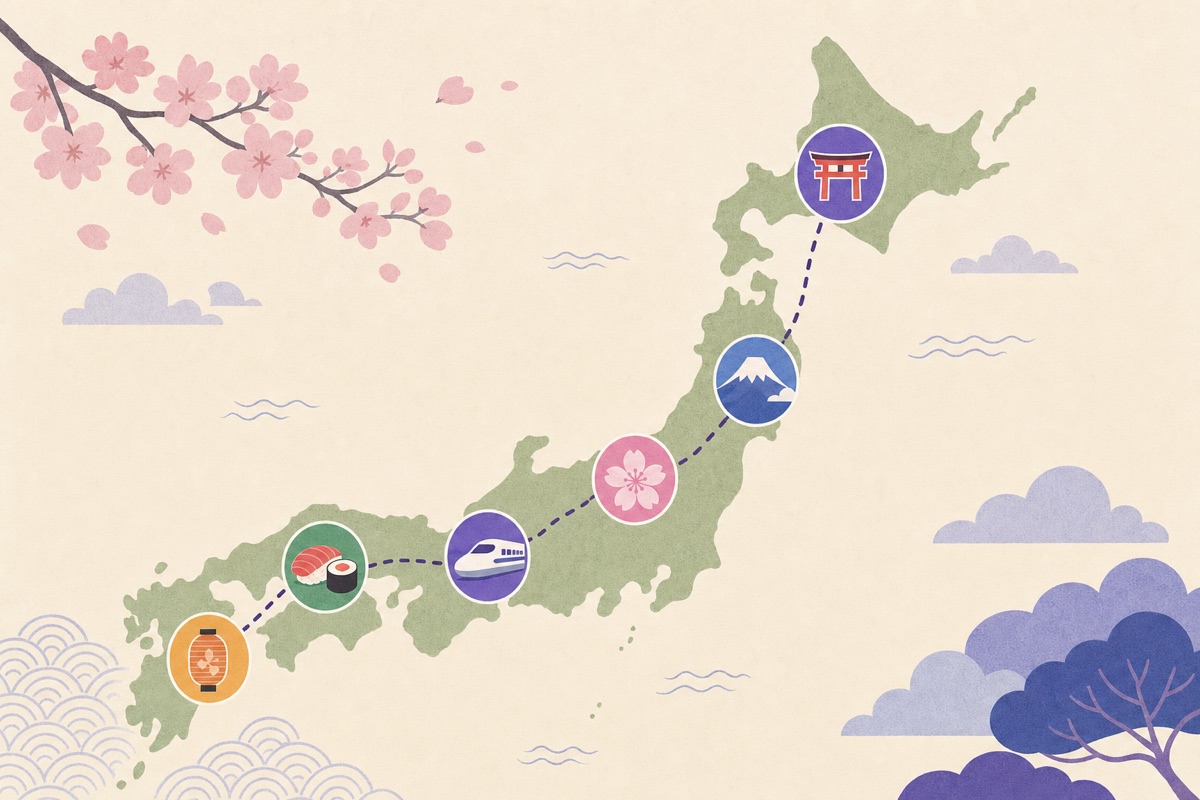
There's a reason nearly every first trip to Japan follows the same arc: Tokyo, Kyoto, Osaka, and one big side trip. It's called the golden route, and some travelers treat that as a warning, as if the "real Japan" must be somewhere else. After years of living here, I'll say it plainly: the golden route is the golden route because it works. Tokyo really is that overwhelming and wonderful. Fushimi Inari really is worth the hype. Nara's deer really do bow.
The mistakes first-timers make are almost never about where they go. They're about pacing. Trying to see three day-trip destinations from Tokyo. Cramming five temples into one Kyoto afternoon. Treating Osaka like a checklist instead of a dinner. So here is the route itself, and more importantly, the rhythm that makes it enjoyable.
Tokyo: 4 to 5 days, one day trip maximum
Give Tokyo at least four full days. It's not one city, it's a dozen cities stitched together, and each neighborhood deserves a half day minimum.
A sane spread looks like this. One day for the west side: Meiji Jingu in the morning while the gravel paths are still quiet, then Takeshita Street when Harajuku wakes up, and end at Shibuya Crossing. Come back for Shibuya Sky at sunset on a clear day; book the slot in advance. One day for the old east: Senso-ji early, Ueno Park for a slow afternoon, then Akihabara if electronics and anime culture pull you. One morning for Tsukiji Outer Market, eaten standing, followed by teamLab Planets nearby. And keep one evening for Omoide Yokocho in Shinjuku, the alley of tiny yakitori counters where you'll have the meal you talk about for years.
Then the day trip. Pick one: Hakone, Kamakura, or Nikko. Not two. Definitely not all three, though I watch people try every year.
- Hakone if you want the classic loop: Hakone Shrine's torii standing in the lake, the volcanic steam vents of Owakudani, and a shot at Mount Fuji if the weather cooperates.
- Kamakura if you want the easiest, gentlest option: the Great Buddha, temples, and the sea, under an hour from Tokyo.
- Nikko if elaborate craftsmanship is your thing: Toshogu is the most ornate shrine complex in Japan, carved and gilded to an almost absurd degree. It's the longest trip of the three, so start early.
If Fuji is the dream, the Chureito Pagoda viewpoint near Kawaguchiko is the famous frame of pagoda and mountain together. It replaces your day trip, it doesn't add to it.
Kyoto: 3 to 4 days, two temples per day
Kyoto is where good trips go to die of exhaustion. The city has over a thousand temples, and the instinct is to see as many as possible. Resist it. My hard rule, and I've lived by it through countless visits: two temples or shrines per day, maximum. After the second one, they blur together and you're just collecting tickets.
Day one: Fushimi Inari at dawn (more on that below), then Kiyomizu-dera in the late afternoon, and walk down through the old lanes into Gion as the lanterns come on. Day two: Kinkaku-ji when it opens, then the rock garden at Ryoan-ji, which is a fifteen-minute walk away and the perfect quiet counterpoint to the golden pavilion's crowds. Day three: the Arashiyama Bamboo Grove early, then a lazy afternoon around Nishiki Market grazing on skewers and pickles. If you have a fourth day, Ginkaku-ji rewards people who preferred Ryoan-ji to Kinkaku-ji, and Nijo Castle is the place to actually walk through shogunate history, complete with floors that chirp underfoot.
This is also where a map pays for itself. Kyoto's sights look close together until you're on the bus. I've pinned all of these on the free companion map for this article, so you can see at a glance which pairs actually share a neighborhood instead of finding out the hard way.
Osaka: the food night. Nara: the half day.
Base yourself in Osaka for two nights near the end of the Kyoto stretch, or day-trip in; either works, since it's fifteen minutes by shinkansen.
Osaka's job in your itinerary is dinner. Dotonbori at night, under the running Glico man, eating takoyaki and okonomiyaki until you can't. If you want a rougher, more retro evening, Shinsekai delivers deep-fried kushikatsu under the old tower. Daytime Osaka is lighter: Kuromon Market for lunch, the castle park for a walk (see Osaka Castle from the outside; the view of it beats the view from it), and the Umeda Sky Building if you want the city from above.
Nara is a half day from either Kyoto or Osaka, and a half day is genuinely enough. Todai-ji's giant Buddha, the lantern-lined paths of Kasuga Taisha, and the bowing deer of Nara Park all sit within one walkable stretch. Go in the morning, be back for dinner.
The choice: west to Hiroshima, or into the mountains
Here's the fork in the route, and you only have time for one side of it.
Hiroshima and Miyajima if this is likely your only trip to Japan, or if history matters to you. The Peace Memorial is sobering and essential, and Itsukushima Shrine's floating torii on Miyajima is one of the country's great sights. Himeji Castle, the finest original castle in Japan, sits right on the shinkansen line between Osaka and Hiroshima, so stop there on the way.
The Kanazawa, Shirakawa-go, and Takayama loop if you've already been drawn to old streets and quiet craft, or if you suspect you'll be back someday. Kanazawa gives you Kenroku-en, one of Japan's three great gardens, and the preserved teahouse district of Higashi Chaya. From there, buses run to the thatched farmhouse village of Shirakawa-go and on to Takayama's old merchant quarter. It's slower, colder in winter, and the Japan most people picture when they close their eyes.
First trip, probably forever? Go west. Already planning trip two in your head? Take the mountains.
Pacing tips I wish someone had told me
- Fushimi Inari before 7am. The torii tunnels are empty, the light is soft, and by 9am it's a queue. This one habit changes the whole memory of Kyoto.
- Temple fatigue is real. It's not a personal failing. Cap it at two a day and spend the saved hours in a market or a garden instead.
- Don't over-pack the Osaka day. Osaka is a mood, not a checklist. One market, one stroll, one big night out.
- Build in one empty afternoon per city. The best moments of every trip I've taken here happened in unplanned hours.
Take the map with you
Everything in this article, all 39 places, is pinned on the free companion map linked on this page. Open it, look around, and if you have an Ikuzo account you can copy the whole thing into your own map in one click, then reshape it: drop what doesn't speak to you, add what does, and turn it into your route. The golden route is a great skeleton. The trip becomes yours in the editing.
Start your own map
Save the places you want to visit, organize them your way, and plan the trip, free.