First Time in Laos: A Two Week Route That Actually Flows
Laos is the calmest first trip in Southeast Asia, and the easiest to route badly. Here's a two week flow built around Luang Prabang, with a north or south extension depending on what you're after.
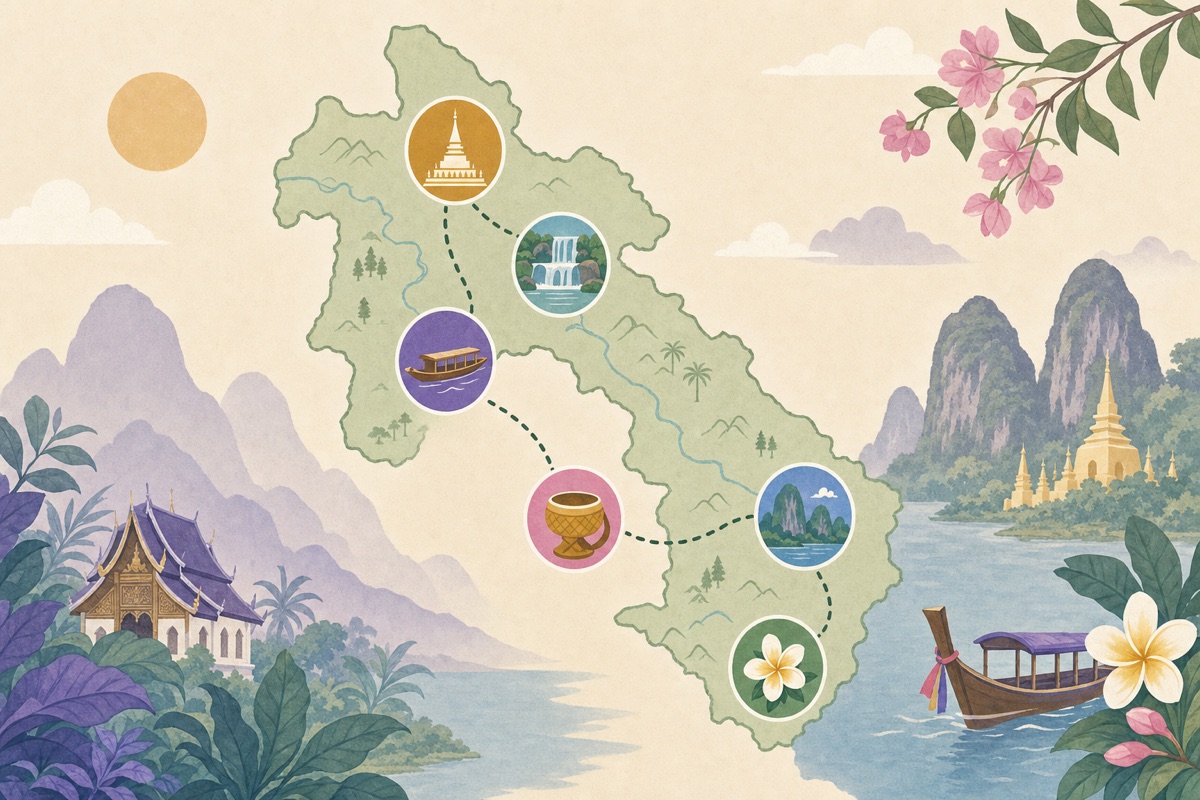
Laos is the trip I recommend to people who are nervous about Southeast Asia. No megacities, no hard sell, no scooter swarms. Just rivers, karst mountains, old temples, and a pace that forces you to slow down whether you planned to or not.
And yet most first-timers route it wrong. They try to do everything in a line, or they bounce between regions that don't connect well, and they spend half the trip in transit. The country is long and thin, the roads are slow, and the good stuff clusters in a few places. The fix is simple: anchor the trip on Luang Prabang, run the spine down to Vientiane, and spend your remaining days on one extension, north or south. Not both.
Here's how two weeks actually flows.
Days 1 to 4: Luang Prabang, the anchor
Fly into Luang Prabang if you can. The old town sits on a peninsula between the Mekong and the Nam Khan, it's compact, and it's the best introduction to the country you could design.
Give it four full days. One for the town itself: Wat Xieng Thong at the tip of the peninsula, Wat Mai next to the Royal Palace Museum, then up Mount Phousi for sunset and down into the Night Market for dinner. One for Kuang Si Falls, the turquoise tiers everyone comes for; go early, swim, and don't rush back. One for the Mekong: a boat upriver to the Pak Ou Caves, packed floor to ceiling with Buddha figures, with a stop at the so-called Whisky Village on the way. And one flexible day for Tad Sae Waterfall or the gardens and ziplines at Nahm Dong Park.
Two quieter things belong in those days too. If you want to see the morning alms on Sakkaline Road, be there before dawn, dress modestly, keep your distance, and stay silent; it's a religious ritual, not a photo event, and it only stays dignified if visitors treat it that way. And spend an hour at the UXO Lao Visitor Centre. Laos is the most heavily bombed country per capita in history, unexploded ordnance still affects rural communities today, and understanding that changes how you see everything outside the towns.
Days 5 and 6: Vang Vieng
The Lao-China Railway changed this trip completely. What used to be a long winding bus ride is now a short train hop, and Vang Vieng went from party pit stop to legitimate two day destination.
The setting is the point here: limestone karsts rising straight out of rice fields along the Nam Song. Day one, rent a bike, swim at Blue Lagoon 1, and climb into Tham Chang Cave for the view back over the valley. Day two, pick your adventure: tubing gently down the Nam Song, pulling yourself through Tham Nam, the water cave, on an inner tube, or hiking up to the Pha Ngern viewpoint. If your budget allows one splurge in Laos, the sunrise hot air balloons here are it; floating over that karst landscape at first light is hard to beat.
All 35 places in this article are pinned on the free companion map embedded below, so you can see exactly how these days cluster on the ground.
Days 7 and 8: Vientiane
Another short train ride and you're in the capital. Vientiane gets dismissed as boring, which is unfair; it's just quiet, and after Vang Vieng that's welcome.
A day and a half covers it well. Pha That Luang, the golden national stupa. Patuxai, the arch you can climb for a view down the avenue. Wat Si Saket with its walls of tiny Buddha niches, and Wat Ho Phra Keo across the street, which once housed the Emerald Buddha. Out of town, Buddha Park is a strange and photogenic sculpture garden worth the detour. In the evening, the Night Market along the Mekong.
Make time for the COPE Visitor Centre. It picks up the UXO story where Luang Prabang left off, focused on the survivors and the prosthetics work done here. It's sobering and genuinely worth your hour.
Days 9 to 14: choose north or south
This is the decision that makes or breaks the route. Both extensions are excellent; doing both in two weeks means spending your trip in buses.
South, for rivers and waterfalls. Head down to Pakse and use it as your base. The Bolaven Plateau loop brings you to Tad Fane, twin falls dropping into a jungle gorge, and the wide curtain of Tad Yuang. Then Wat Phou, a Khmer temple complex older than Angkor Wat, climbing a hillside above the Mekong. Finish in the 4000 Islands: base yourself on Don Det, cycle to Li Phi Falls, and visit Khone Phapheng, the largest waterfall in Southeast Asia by volume. Hammock time is mandatory. This is the classic ending, and the easiest logistically.
North, for mountains and mystery. If you choose north, flip the order: do it from Luang Prabang before heading down the spine. Nong Khiaw is a few hours away, and the viewpoint above town is one of the great panoramas of Southeast Asia. From there, a boat up the Nam Ou reaches Muang Ngoi Neua, a village with no through road and nothing to do, in the best sense. Add the Plain of Jars if archaeology pulls at you: thousands of ancient stone jars scattered across windswept hills, still not fully explained.
First trip, no strong preference? Go south. It flows in one direction with no backtracking.
A few practical notes
The railway is the backbone: it connects Vientiane to Luang Prabang in a couple of hours, with a stop at Vang Vieng, and tickets sell out, so book as early as the system allows. The two day slow boat down the Mekong from the Thai border at Huay Xai to Luang Prabang is a beautiful alternative entrance if you have the time. Carry cash outside the main towns, expect things to run late, and never wander off marked paths in the countryside; that's the practical side of the UXO story.
The map
Everything above, all 35 spots from Kuang Si to Khone Phapheng, is pinned on the free map embedded below this article. Open it, see how the route actually sits on the geography, and if you have an Ikuzo account you can copy the whole map into your own and reshape it: swap the extension, add your own finds, turn it into your trip. That's the whole idea. Laos rewards travelers who plan gently and leave room. Build the map, then let the Mekong set the pace.
Start your own map
Save the places you want to visit, organize them your way, and plan the trip, free.