Every Notable Impact Crater on Earth, Mapped
From the crater that ended the dinosaurs to a German town built inside one, 64 confirmed impact structures on a single map. Filter them by size, by state, or by whether you can actually stand on the rim.
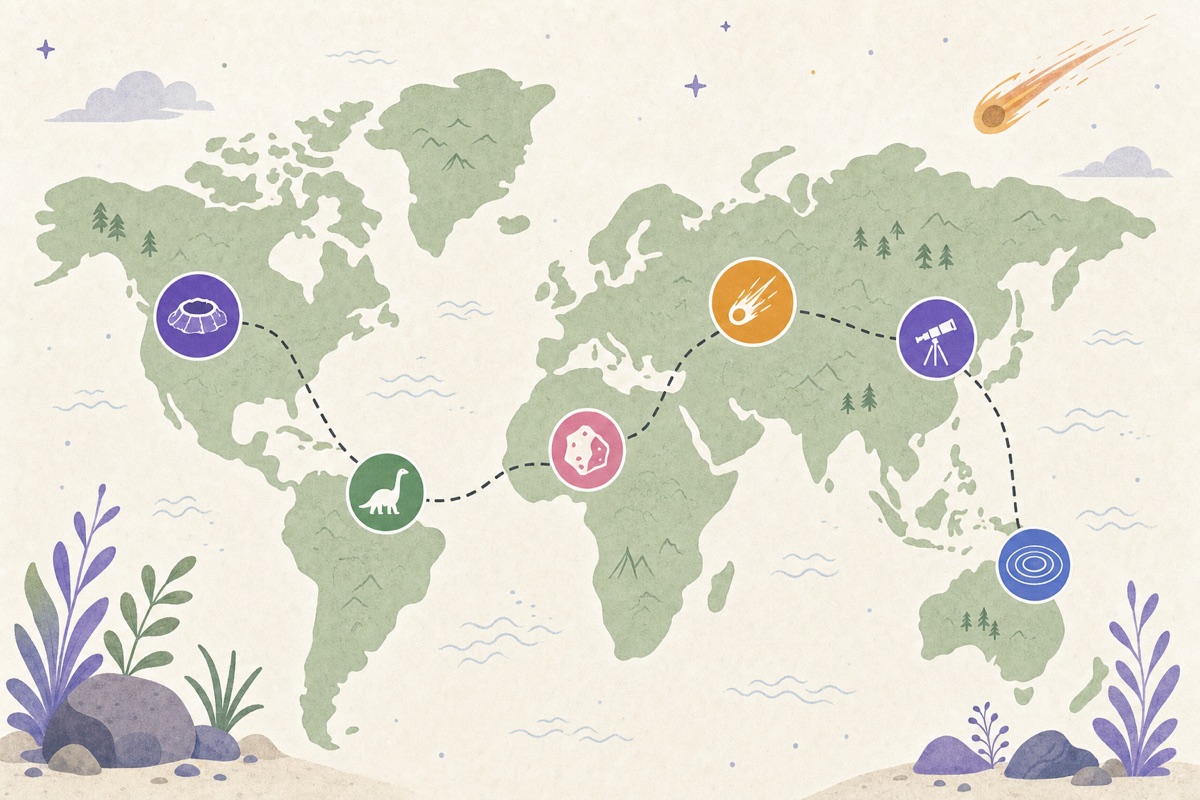
Earth gets hit. Constantly, in geological terms. Most scars are erased by erosion, oceans, and plate tectonics, which makes the ones that survive strangely precious: each confirmed crater is a place where you can stand and know, with certainty, that something arrived from space and rewrote the landscape in seconds.
I wanted to see them all at once, so I mapped them. The map holds 64 confirmed impact structures, from holes you could walk across in a minute to a buried ring the size of a small country. Here's a tour of the highlights.
The one that changed everything
Buried under the Yucatán Peninsula in Mexico, half on land and half under the Gulf, sits Chicxulub. Sixty-six million years ago an asteroid roughly the size of a city struck here, and the fallout ended the reign of the dinosaurs along with about three quarters of species on Earth. There's nothing dramatic to see at the surface today, just quiet towns and a faint ring of sinkholes tracing the crater's rim. That contrast is exactly why it belongs on the map: the most consequential few minutes in the history of complex life, and you'd drive across it without noticing.
The giants
Chicxulub isn't even the biggest. That title goes to Vredefort in South Africa, the largest confirmed impact structure on Earth, formed around two billion years ago. Today it survives as a dome of uplifted ancient rock with farmland draped over it. Sudbury in Canada is nearly as old and so rich in metals delivered and concentrated by the impact that an entire mining city grew inside it. Popigai in Siberia is younger and stranger: the impact compressed carbon in the ground into industrial quantities of diamonds. And for the record books, the oldest confirmed crater of all is Yarrabubba in Western Australia, at roughly 2.23 billion years, its shape long gone but its signature still readable in the rock.
The time capsule
If you want the textbook crater, the one that looks like the diagrams, go to Barringer Crater in Arizona, better known as Meteor Crater. It's about 50,000 years old, dry desert air has kept it almost perfectly intact, and it's the most pristine impact crater you can casually visit. You park, walk to the rim, and look down into a bowl over a kilometer wide. This is also where, in the early 1900s, geologists first proved a crater on Earth came from space and not a volcano.
The town inside a crater
My favorite spot on the whole map is Nördlingen in Germany. It's a lovely medieval walled town, and the entire thing sits inside the Ries crater, a 15 million year old impact basin. The builders quarried local stone called suevite, which formed in the impact itself, so the town's buildings, including St. George's Church, contain countless microscopic diamonds created in the collision. The residents knew none of this for centuries; they assumed they lived in an old volcano.
The ones you can swim in
Some craters became lakes, and a few are genuinely beautiful. Lonar in India is a crater lake punched into solid basalt, ringed by temples. Pingualuit in northern Quebec holds some of the clearest water on the planet inside a nearly perfect circle. Lake Bosumtwi in Ghana is the country's only natural lake and a sacred place for the Ashanti. And on the Estonian island of Saaremaa, the small Kaali craters formed recently enough that the event likely entered local memory, and they figure in Estonian mythology as a place where the sun, or a god, fell to earth.
The recent arrivals
Impacts aren't ancient history. In 1947 the Sikhote-Alin fall in eastern Russia peppered a hillside with iron meteorites and small craters. In 2007 a stone struck Carancas in Peru and left a fresh crater by a village. And in 2013 the Chelyabinsk meteor exploded in an airburst over a Russian city, shattering thousands of windows; the largest fragment was later pulled out of Lake Chebarkul. All three are on the map.
The event with no crater
Tunguska, Siberia, 1908: the largest impact event in recorded history flattened some 2,000 square kilometers of forest, yet left no crater at all, because the object exploded in the air before reaching the ground. I've pinned the epicenter anyway. Some scars are made of absence.
Desert gems
Deserts preserve craters the way attics preserve photographs. Wolfe Creek in Australia is a huge, crisp bowl that features in the Dreaming stories of the local Aboriginal peoples, as does Gosses Bluff, known as Tnorala, held to be the place where a celestial baby fell to the ground. Tenoumer in Mauritania is an almost perfect circle in bare rock, and tiny Kamil in Egypt is so fresh and undisturbed it was first spotted on satellite imagery.
Finding your kind of crater
Sixty-four pins is a lot, so every spot is tagged. Size tags (#giant, #large, #small) separate the planet-scarring monsters from the backyard bowls. State tags (#exposed, #buried, #lake) tell you whether there's anything to see, and #visitable marks the ones with real access. Type #visitable and #exposed into the filter and the map instantly reduces to the craters worth planning a trip around, Barringer, Nördlingen, Lonar, Wolfe Creek and friends.
The map is free to browse, and if you're logged in you can copy the whole thing into your own account and build your own impact pilgrimage on top of it. Earth kept the receipts. Go see them.
Start your own map
Save the places you want to visit, organize them your way, and plan the trip, free.