
Turn a List of Places Into a Day-by-Day Itinerary
You've saved fifty places you want to visit. Now what? Here's how to turn a pile of pins into a realistic day-by-day plan that survives contact with a real trip.
There's a moment in every trip's planning where excitement turns into paralysis. You've collected fifty places you'd love to see. They're all good. And you have six days. Suddenly the fun part is over and you're staring at a map thinking: how do I actually fit this together?
This is the gap between a wishlist and a plan. A wishlist is "places I like." A plan is "here's what we're doing Tuesday." Closing that gap is mostly mechanical once you know the moves. Here's the process.
Group by geography, not by interest
The instinct is to organize your list by type: temples here, restaurants there, viewpoints in another bucket. Resist it. Categories are how you think about places; geography is how you visit them.
A real day is a loop through one area. So the first move is to look at your map and find the natural clusters, the places that sit close enough to see in one go. Five pins bunched in one neighborhood is a day. Two pins on opposite sides of the city are two different days, even if they're the same type of thing.
When you let location lead, the itinerary almost draws itself. You're not deciding "what do I want to do Tuesday" from scratch. You're noticing that these four places are neighbors, and that's Tuesday.
Build days as routes, not lists
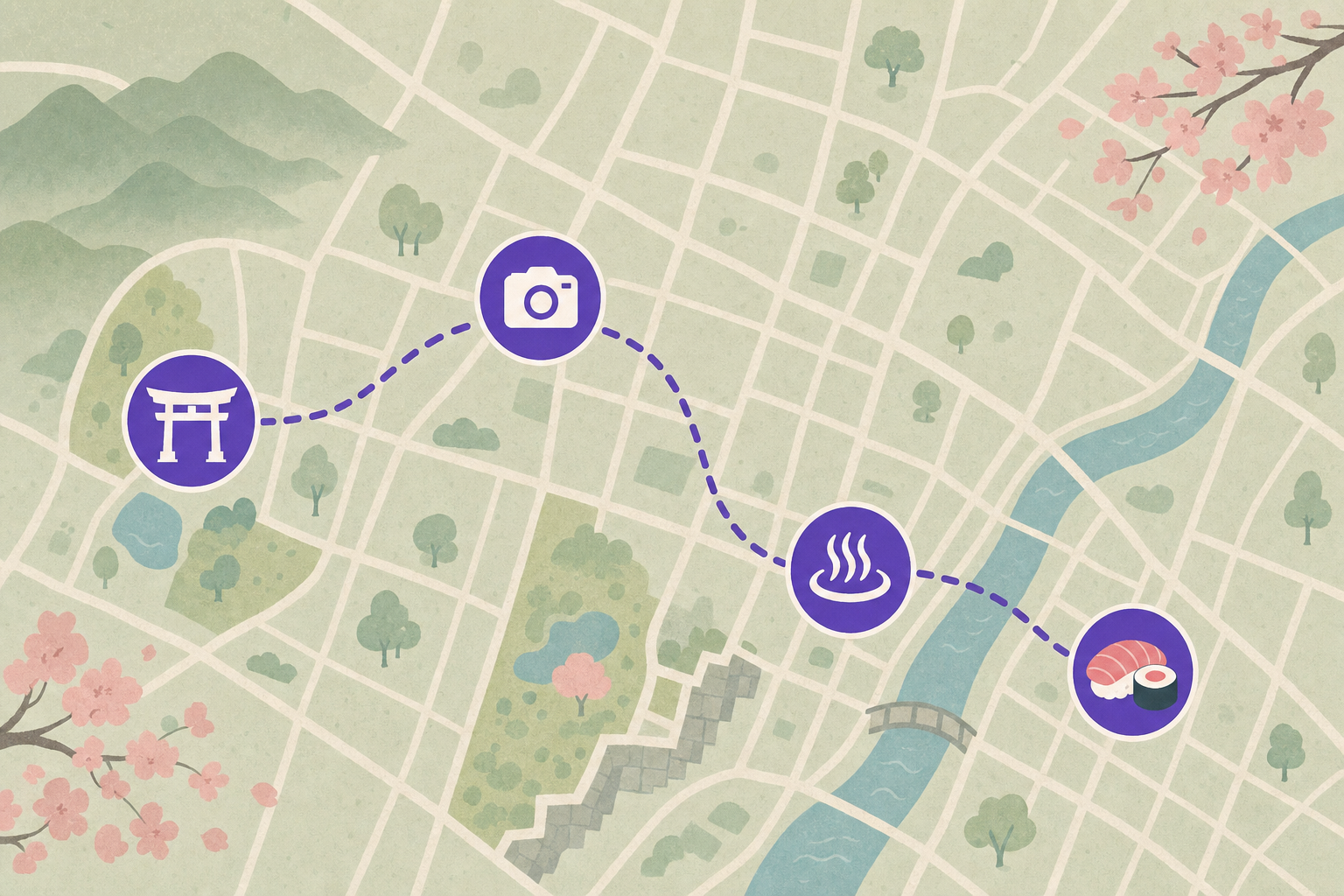
Once a day's places are grouped, order them so you're not backtracking. This is where a travel plan earns its keep: instead of a flat checklist, you lay the day out as a sequence and draw the actual route between stops.
The moment you see the line connecting your stops, problems jump out. "Oh, this puts us crossing the whole city at lunchtime." "These two are a five-minute walk apart, but I had them on different days." You fix it by dragging stops into a better order and watching the route redraw. Five minutes of this saves an hour of real-world wandering.
It also tells you the truth about distance and time. A day that looked reasonable as a list might be four hours of walking once you see it as a route. Better to learn that now than at 3pm with sore feet.
Be honest about how much fits in a day
The single most common planning mistake is cramming. On paper, eight stops looks efficient. In reality, you'll do four well or eight badly.
Travel is slower than it looks on a map. Things take longer, you linger where it's good, you get lunch, you rest. A useful rule of thumb: pick a small number of anchors per day (the things you'd be sad to miss) and treat everything else as optional. Mark the must-dos clearly and let the maybes fill gaps if the day has room.
When you can see distance and estimated time for the whole day at a glance, this gets easy. A day that totals two relaxed hours of moving has room for spontaneity. A day that totals six hours doesn't. Cut something now, while it's painless.
Plan across days, not just within them
A trip isn't six independent days; it's a sequence. Looking at the whole thing together catches problems a single day can't:
- The far-flung place is best done on the day you change hotels, not as a round trip.
- Two heavy days back to back will wreck you, so put an easy one between them.
- The thing that's only open on weekends has to land on Saturday or Sunday.
Laying your days out side by side (each as its own route, in order) turns the trip into something you can actually reason about. You stop optimizing single days and start shaping the arc of the whole trip.
Leave room for the trip to breathe
A plan isn't a script. The goal isn't to schedule every minute; it's to remove the decisions that are annoying to make in the moment (where's lunch, what's near here, how do we get there) so the trip itself stays open.
The best plans have gaps on purpose. An afternoon with nothing booked. A "if we feel like it" list of nearby maybes. The structure exists so you can relax inside it, not so you can race through it.
So take your pile of pins and start grouping. Make one day a real route. Then another. Before long the trip stops being an intimidating list and becomes a sequence of days you can already picture yourself living. That's the whole point: not a perfect schedule, but the quiet confidence of knowing roughly where Tuesday goes.
Start your own map
Save the places you want to visit, organize them your way, and plan the trip, free.