Stand Where the Painters Stood: 40 Real Places Behind Famous Paintings
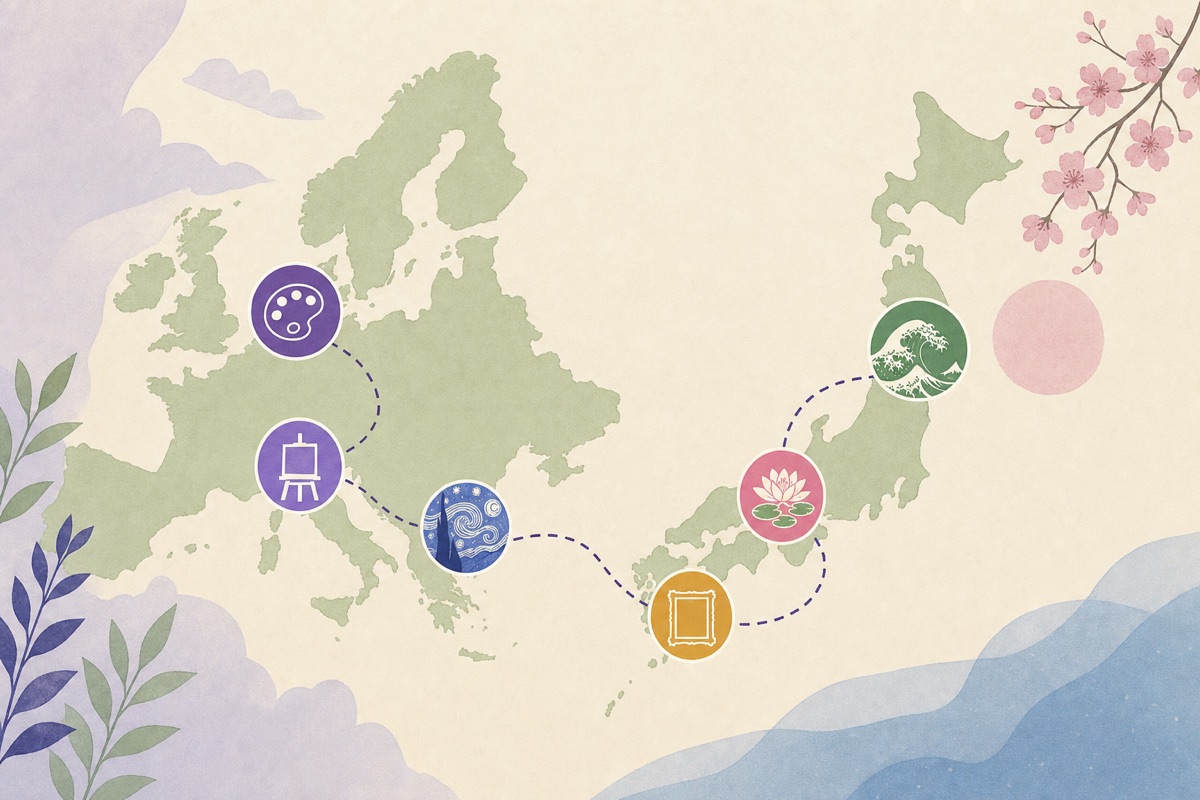
A map of 40 real locations where famous paintings were made, from Van Gogh's café in Arles to Hokusai's coast facing Fuji. Most of them are still recognizable today, and you can stand exactly where the easel stood.
There's a strange thrill in standing where a painter stood. You've seen the image a hundred times in books and on museum walls, and then you turn a corner in a small French town and it's just... there. The same café, the same bridge, the same bend in the coastline. The painting suddenly stops being an object and becomes a moment someone lived.
That's the idea behind this map: 40 real places where famous paintings were painted. Not museums (though I'll tell you where the originals hang), but the actual spots. The surprising part is how many of them are still recognizable. You can line up the view with the canvas and feel a century collapse.
The Van Gogh trail
If any painter left a trail you can physically walk, it's Van Gogh. His last few years read like an itinerary through the south of France, and the map follows it.
Start on Place du Forum in Arles, where the café from Café Terrace at Night still serves coffee under the same yellow awning. It's touristy, sure, and the coffee won't change your life, but sitting there at dusk as the sky goes that deep blue is worth every cent. A short ride away, the Langlois bridge (now known as Pont Van Gogh) still crosses the canal, drawbridge and all.
Then comes Saint-Rémy-de-Provence, where Van Gogh checked himself into the asylum of Saint-Paul-de-Mausole. You can visit the garden he painted obsessively, the olive groves, the view of the Alpilles. This is where the Starry Night period happened, painted from his room and from memory. The painting itself hangs at MoMA in New York, but the landscape that fed it is all around you.
The trail ends in Auvers-sur-Oise, north of Paris, at the church from The Church at Auvers (the original is in the Musée d'Orsay). The building has barely changed. Van Gogh painted it weeks before his death, and he's buried a short walk away, next to his brother Theo.
Monet's places, still wet
Monet is the other painter whose world survived almost intact. Giverny is the obvious one: the pond with the Japanese bridge and the water lilies is not a reconstruction, it's the actual garden he built and painted for thirty years. Go early, go on a weekday, and you'll get a few minutes of it nearly alone.
In Rouen, you can stand across from the cathedral facade he painted over thirty times in changing light. And in Étretat, the chalk cliffs and the natural arch look exactly like his canvases, because cliffs don't age on human timescales. The big Water Lilies panels live at the Orangerie in Paris, and several Rouen Cathedrals hang at the Orsay, so you can pair the places with the paintings in one trip.
Japan, one wave at a time
The ukiyo-e masters painted views, and views can be found again. The map includes the stretch of coast near Kanagawa that looks toward Mount Fuji, the setting of Hokusai's Great Wave (impressions of the print hang at the Met, the British Museum, and elsewhere, since it's a woodblock print with many copies). There's Nihonbashi in Tokyo, the bridge where both Hokusai's and Hiroshige's Tokaido series begin, now sitting under an expressway but still marking kilometer zero of Japan. And there's the north shore of Lake Kawaguchiko, one of the classic candidates for the view behind Red Fuji.
One honest note: some of these ukiyo-e viewpoints are approximate or genuinely debated by scholars, and the map says so in the spot descriptions. Hokusai composed freely and moved mountains when it suited him. Treat those pins as "the best current guess," which is its own kind of fun.
The rest of the gallery
A few favorites from the other 20-some pins. The road above Oslo, on Valhallveien, where Munch felt the sky turn to blood and painted The Scream (the originals are split between Oslo's National Museum and the Munch Museum). The Bastei rocks in the Elbe Sandstone Mountains, the jagged landscape behind Friedrich's Wanderer above the Sea of Fog, now in Hamburg's Kunsthalle. The spot across the harbor in Delft where Vermeer painted his View of Delft, which you can compare with the original at the Mauritshuis in The Hague, twenty minutes away.
America gets its classics too: the little white house with the Gothic window in Eldon, Iowa, still standing behind where the farmer and his daughter posed for American Gothic (Art Institute of Chicago), and the Olson House in Cushing, Maine, the weathered farmhouse on the hill from Wyeth's Christina's World (MoMA again), which you can actually walk through.
Filter by artist, movement, or "still looks like the painting"
Forty pins across three continents is a lot, so the map uses hashtags. Filter by artist (#vangogh, #monet, #hokusai) to follow one painter's trail, or by movement (#impressionism, #ukiyoe) to theme a whole trip. My favorite is #recognizable, which marks the views that still genuinely match the canvas, for when you want the full stand-in-the-painting effect rather than a plaque and some imagination.
Take it, it's yours
The map is free and public. Open it, browse the pins, read the notes about what changed and what didn't. And if a painting trip starts forming in your head, copy the whole map into your own Ikuzo account and build on it: add your hotels, your route, your own pins. Then go stand where the painters stood.
Start your own map
Save the places you want to visit, organize them your way, and plan the trip, free.