Unsolved Mysteries and Lost Treasures: 45 Places That Keep Their Secrets
A map of 45 real locations behind the world's great mysteries: vanished crews, buried treasure, ancient ruins nobody can explain, and a few cases science finally cracked. Every pin tells you honestly whether the mystery is still open.
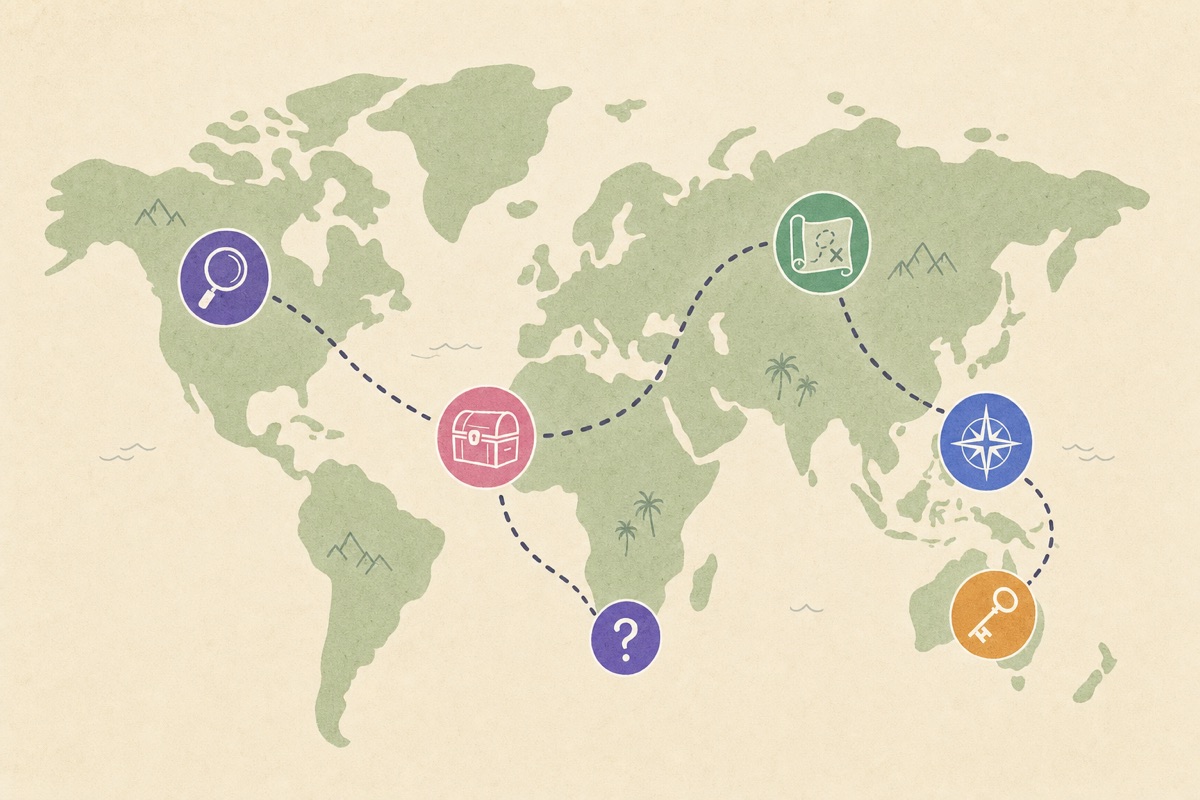
Every mystery happens somewhere. The Dyatlov Pass has coordinates. The lighthouse where three keepers vanished is still standing, and you can look at it from a boat. Somewhere off Cartagena, a Spanish galleon is sitting on the seabed with billions in silver. I kept collecting these places, and eventually they became a map: 45 locations behind the world's most stubborn mysteries.
One rule made the map worth building: every pin is honest about its status. Some of these cases are genuinely unsolved. Some have been explained, and the explanation is often better than the legend. One treasure has actually been found. The map tells you which is which, because a mystery map that pretends everything is still mysterious is just a ghost story.
The vanishings
The heart of the map is the places where people simply stopped being there.
The Dyatlov Pass in the Urals, where nine experienced hikers cut their way out of their own tent in 1959 and died in the snow. A 2021 study made a strong case for a rare slab avalanche, but not everyone is convinced, so the pin says what we know and what we don't. The Flannan Isles lighthouse off Scotland, where three keepers vanished in December 1900 leaving a stopped clock and an overturned chair. Roanoke, the English colony that disappeared between 1587 and 1590 with one word, CROATOAN, carved into a post.
Then the modern ones. Somerton Beach in Adelaide, where a well-dressed man was found dead in 1948 with a scrap of Persian poetry in his pocket. DNA finally gave him a name in 2022, which the pin duly notes, but why he died is still anyone's guess. The forests of southwest Washington where D.B. Cooper jumped out of a Boeing 727 in 1971 with $200,000 and was never seen again, though some of the cash surfaced on a riverbank in 1980. And Howland Island, the speck of Pacific coral Amelia Earhart was flying toward in 1937 and never reached. The pin sits on the destination, which somehow makes it sadder.
The treasure hunts
This is the section people open first, and I understand why.
Oak Island's Money Pit in Nova Scotia has been dug, flooded, re-dug and televised since 1795, and nobody has conclusively found anything. The Amber Room, an entire chamber of amber panels looted from a Russian palace, was last seen in Königsberg in 1945; the pin marks its final confirmed location, now Kaliningrad. The Beale ciphers point to a vault of gold supposedly buried in Bedford County, Virginia. Only one of the three ciphers has ever been cracked, using the Declaration of Independence as the key, and it is the one describing the treasure rather than where it is.
Two pins here break the pattern honestly. The San José galleon, sunk by the British in 1708 off Cartagena, was located in 2015, so the mystery is no longer where it is but who gets the cargo. And Forrest Fenn's treasure chest, hidden in the Rockies in 2010, was found in Wyoming in 2020. The pin marks the hunt, not a payday, and says so plainly. Thousands of people spent a decade searching, and that story deserves a place on the map even finished.
The ancient enigmas
Some places are mysterious not because something happened there, but because we can't explain how they exist at all.
Göbekli Tepe in Turkey is a complex of carved stone circles built around 11,000 years ago, before agriculture, before pottery, before anything we thought made monuments possible. Nan Madol sits on a reef in Micronesia, a city of basalt columns stacked like log cabins on artificial islets, with no clear answer as to how the stones got there. The Nazca Lines in Peru we can date and even explain technically; why a desert needed hundred-meter drawings visible only from above is still open. And off Yonaguni, Japan's westernmost island, divers circle a stepped stone formation that some see as a sunken monument and most geologists see as natural fracturing. The argument has been running for decades and the pin doesn't pick a side.
Solved, and proudly labeled
My favorite pins are the ones where science caught up. Racetrack Playa in Death Valley, where boulders leave long trails across the mud, was finally observed in the act in 2014: thin sheets of ice, light wind, moving rocks. Blood Falls in Antarctica turned out to be iron-rich brine from a subglacial reservoir, rusting on contact with air. The Devil's Kettle in Minnesota, the waterfall that swallows half a river into a hole, was measured in 2017 and the water simply rejoins the river underneath.
Against those, the still-open ones stand out sharper: the Taos Hum, a low drone some residents of one New Mexico town hear and no instrument has explained, and the Patomskiy crater, a strange stone mound in the Siberian forest that geologists are still arguing about.
Finding your kind of mystery
The spots carry hashtags, so you can filter the map to your taste: #treasure, #disappearance, #ancient, and the two that give the map its character, #explained and #unsolved. Toggle #unsolved and you get only the cases still open. Toggle #explained and you get a quiet tour of human curiosity winning.
The map is public and free, and if you're logged in to Ikuzo you can copy the whole thing into your account, add your own local legends, or build a road trip around the pins near you. Mysteries are better with coordinates.
Start your own map
Save the places you want to visit, organize them your way, and plan the trip, free.